By October, the excitement of a new school year has usually worn off. What’s left is the daily reality: keeping every subject on track, answering a dozen questions a day, and wondering if you’re doing enough. If that sounds familiar, you’re not failing. You’re carrying a load that was never meant for one person alone.
The good news is that reducing parent stress during the school year doesn’t require a total overhaul of your homeschool plan. It usually comes down to a few honest shifts: sharing the teaching load, leaning on the people already built into your support system, and protecting a schedule that works for your whole family, not just your student.
Why the School Year Gets Heavier for Homeschool Parents
The first few weeks of a new school year tend to run on momentum. New supplies, a fresh schedule, everyone excited to start. By October and November, that momentum has faded, and the real work sets in.
For homeschool parents, that work is significant. Depending on your setup, you may be the one planning lessons, teaching subjects you haven’t touched since your own school days, keeping records for your partner school, and motivating a student who would rather be doing anything else. There’s no staff room to walk into and no colleague down the hall to compare notes with.
That isolation is a big part of why stress builds. Traditional classroom teachers share the load with other teachers, an administrator, and a support staff. Homeschool parents often do it all themselves, on top of everything else that comes with running a household.
You Don’t Have to Teach Every Subject Yourself
One of the most direct ways to reduce that load is to stop trying to teach every subject yourself. This is where live, teacher-led classes make a real difference.
With Branches Learning, students join live online classes taught by a real teacher, in real time, with other students in the room. That’s a meaningful distinction from self-paced software, where a parent often still has to sit alongside the student, explain the material when a lesson doesn’t land, and manage the pacing themselves. Live instruction puts that responsibility back where it belongs: with a teacher who is trained to teach that subject.
If math, Spanish, or science has become the subject you dread each week, it may be worth handing that piece to a live class instead of managing it solo. Browse the full course catalog to see which subjects are available for your student’s grade level.
Leaning on Your Homeschool Teacher (HST) and Support Team
If your family works with a Homeschool Teacher (HST) through your partner school, that relationship is one of the most underused stress-reduction tools available. An HST isn’t just there for paperwork and compliance check-ins. They’re a thought partner who has seen dozens of families work through the exact scheduling conflicts, motivation slumps, and subject struggles you’re facing right now.
Use your scheduled HST meetings to actually talk through what isn’t working, not just to confirm attendance and submit samples. If a subject feels too heavy, if your student is falling behind, or if your own schedule is stretched too thin, your HST can help you figure out what to adjust, including whether adding a live class or tutoring support makes sense.
Building a Schedule That Protects Your Own Bandwidth
A schedule that only accounts for your student’s classes and assignments will eventually run you into the ground. Reducing parent stress during the school year means building a schedule that protects your time too.
A few principles that help:
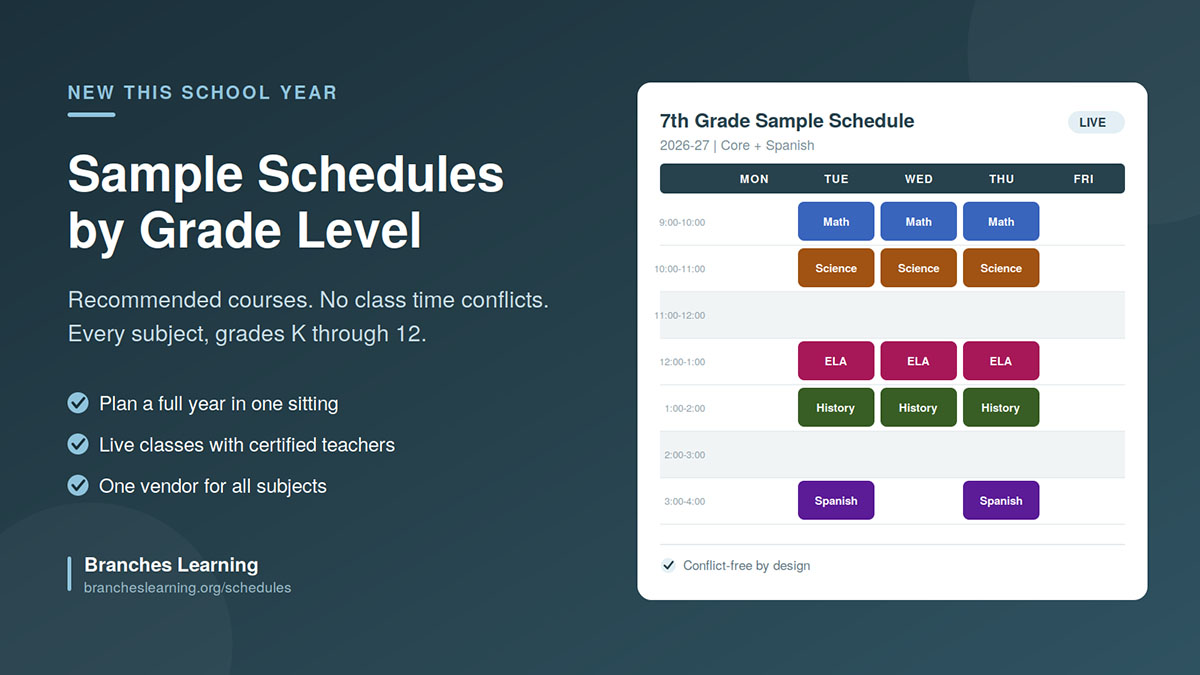
- Anchor your week around live class times. When certain subjects happen at a fixed time with a teacher, you don’t have to decide when to fit them in. That decision is already made for you.
- Batch your planning tasks. Instead of planning day by day, set aside one block each week to look ahead. Constantly re-planning is one of the quiet drains on parent energy.
- Build in buffer time. Homeschool days rarely go exactly as planned. A little slack in the schedule means one rough morning doesn’t throw off your entire week.
Consistency reduces decision fatigue. The fewer decisions you have to make on the fly each day, the more mental energy you have left for everything else.
Small Class Sizes Mean Less Reteaching at Home
One stress point parents don’t always expect is reteaching after a lesson. A student comes away from an assignment confused, and the parent ends up trying to explain a concept they may not fully remember themselves.
Small class sizes help prevent that gap. When a student is one of a handful in a live class instead of one of dozens, they have real opportunities to ask questions and get an answer directly from the teacher, in the moment. Students build a genuine relationship with their teacher over the course of a semester, which makes them more comfortable speaking up when something doesn’t make sense.
That means fewer confused assignments landing on the kitchen table at 4 p.m., and fewer moments where a parent has to become a substitute subject expert on short notice.
Signs It’s Time to Add More Support
Sometimes the answer to parent stress isn’t a scheduling tweak. It’s recognizing that your family could use more support than your current plan provides. A few signs worth paying attention to:
- Schoolwork has become a daily source of conflict rather than an occasional rough patch.
- Your student is consistently behind in one or more subjects, and the gap keeps growing.
- You feel dread, rather than neutral or positive anticipation, when a particular subject comes up.
- You’re spending more hours reteaching material than your schedule realistically allows.
None of these mean you’ve done something wrong. They mean it’s a good time to talk with your HST about adding a live class or tutoring support in that subject. Asking for help partway through the year is common, not a sign of falling behind on your responsibilities. Our tutoring page explains how one-on-one and small-group support works.
A Few Small Habits That Add Up
Along with bigger structural changes, a handful of small habits can steadily lower stress over the course of a school year:
- Do a short weekly check-in with your student about how each subject is going, before problems pile up.
- Protect one planning block each week where you’re not also actively teaching.
- Notice small wins out loud. A finished project or a subject that clicked is worth acknowledging, for your student and for yourself.
- Say no to extra commitments during already full weeks. The school year doesn’t need to include everything.
None of these habits will erase every stressful week. But together, they add up to a homeschool year that feels manageable, not overwhelming.
A Lighter Load Is Possible
Reducing parent stress during the school year isn’t about doing more. It’s often about doing less yourself and letting the people and structures around you carry their share. A live class taught by a teacher who knows the subject, a Homeschool Teacher who knows your family, and a schedule that protects your own time can make a bigger difference than any single productivity trick.
If a particular subject has become a weekly source of stress in your home, review the course catalog or reach out to your HST about what support might be available for the rest of the year.
Frequently Asked Questions
How do live online classes reduce the workload for homeschool parents?
Live classes are taught in real time by a teacher, so students get direct instruction and can ask questions as they come up. That reduces how often a parent needs to reteach material or manage pacing on their own, unlike with self-paced software.
What should I talk about with my Homeschool Teacher (HST) if I’m feeling overwhelmed?
Your HST can help with more than attendance and paperwork. Bring up specific subjects that feel too heavy, scheduling conflicts, or signs your student may need more support, and ask what options are available through your partner school.
Is it normal to add tutoring or classes partway through the school year?
Yes. Many families adjust their plan once they see how the year is actually going, rather than sticking rigidly to what was set at the start. Adding support mid-year is a common and reasonable adjustment.
How small are Branches Learning class sizes?
Class sizes are kept small so students can interact meaningfully with their teacher and classmates. Specific class size details are available on the course catalog page for each subject and grade level.