When families move to independent study, one worry comes up again and again: will my student still get the “extras”? Art class, a foreign language, a chance to pick up an instrument. Those subjects often feel like the first thing to disappear once a family leaves a traditional classroom. At Branches Learning, they don’t have to.
Families have access to live online electives taught by real teachers, in real time, alongside other students. That means your student can still explore Spanish, visual art, music, or Ethnic Studies, without giving up the flexibility that made independent study appealing in the first place.
Here’s why live online electives matter, and what your student can choose from this year.
What Are Electives, and Why Do They Matter in a Homeschool Plan?
Electives are the courses students choose based on interest rather than requirement. Where core subjects like math and English language arts build foundational skills, electives let a student go deeper into something they care about, whether that’s language, art, music, or a subject like Ethnic Studies.
For independent study families, electives do a few important jobs at once:
- They round out a student’s schedule with subjects beyond the core.
- They give students a low-pressure way to try something new.
- For high schoolers, many electives carry A-G credit, which matters for college eligibility.
- They add variety to a week that might otherwise be heavy on textbook work.
A strong homeschool plan isn’t just about covering requirements. It’s about building a schedule your student is actually excited to log into. Electives are often where that excitement lives.
Why Live Instruction Makes a Difference in Electives
Not all online electives are built the same way. Some are self-paced, meaning a student works through slides or videos alone, with no teacher present and no classmates to interact with. Others, like every course at Branches Learning, are live and teacher-led.
The difference shows up most in electives. A self-paced art lesson can show a student a technique. A live art class lets a teacher watch a student work, offer feedback in the moment, and adjust the lesson based on what students in the room actually need. The same is true for world language courses, where conversation and pronunciation depend on real-time back-and-forth, not a recorded video.
Live electives at Branches Learning are also kept in small class sizes, so students aren’t lost in a crowd. A student learning to play an instrument or working through a Spanish conversation gets actual attention from the teacher, not just a lesson broadcast to hundreds of students at once.
This is the core of the Branches Learning model: students learn live, with a teacher, not through self-paced software. For skill-building subjects like art, music, and language, that distinction matters more than it might for a subject that’s mostly reading and worksheets.
Think about what it takes to actually learn to roll a Spanish “r,” shade a portrait, or find the right rhythm on a guitar. These are skills built through repetition and correction, not just information a student can absorb once and remember. A recorded video can demonstrate a skill. It can’t watch a student attempt it and tell them what to adjust. A live teacher can, in the moment, before a habit sets in the wrong way.
There’s also a motivation piece that’s easy to overlook. Showing up to a live class at a set time, knowing a teacher and classmates are expecting you, builds a different kind of accountability than logging into a self-paced module whenever it’s convenient. For students who thrive on structure and connection, that weekly rhythm can be the difference between an elective that sticks and one that quietly gets skipped.
Choosing the Right Elective for Your Student
With several elective paths available, it helps to think about what your student actually wants out of the class, not just what looks good on paper. A student who loves performing might gravitate toward Instrumental Music. A student who wants to build practical skills for travel, family connection, or future coursework might be a better fit for the Spanish sequence. A student who processes the world visually might light up in Visual Arts.
It’s also worth considering pacing. Younger students in Art K-1, Art 2-3, or Art 4-5 are working on foundational creative skills in a low-pressure, enrichment-focused setting. High schoolers choosing between Visual Arts 1 and 2, the Spanish sequence, Instrumental Music, or Ethnic Studies are often thinking further ahead, toward A-G credit and a transcript that reflects their interests. Neither approach is better. They’re built for where a student is developmentally.
Electives Branches Learning Offers Blue Ridge Academy Families
Branches Learning’s elective lineup covers world language, visual and performing arts, and enrichment options for younger students. All classes are synchronous, meaning students meet live on a set schedule with a teacher and classmates.
World Language
Students can start exploring Spanish as early as grade 6 and build toward high school credit:
- Spanish Exploration, Grades 6/7
- Spanish Exploration, Grade 8
- Spanish 1 AB
- Spanish 2 AB
- Spanish 3 & 4 AB
Spanish 1 AB, Spanish 2 AB, and Spanish 3 & 4 AB are A-G credit eligible, which is worth noting for high school families thinking ahead to college applications.
Visual & Performing Arts
High school students can choose from:
- Visual Arts 1 AB
- Visual Arts 2 AB
- Instrumental Music 1 AB
These courses are also A-G credit eligible, so a student building a college-ready transcript can pursue an art or music interest without sacrificing academic credit.
Art Enrichment for Younger Students
Elementary students have their own dedicated art classes, scaled to their grade band:
- Art K-1
- Art 2-3
- Art 4-5
These enrichment classes give younger students an early, low-stakes introduction to creative expression, taught live by the same teacher-led model used across every Branches Learning course.
Social Sciences Elective
High school students can also enroll in Ethnic Studies, a discussion-based course that explores identity, culture, and history.
See the full course catalog for current schedules, teachers, and seat availability, since course days and times can shift from term to term.
Social and Engagement Benefits of Live Online Electives
One of the quieter concerns families have about independent study is whether their student will still feel connected to other kids. Live electives help close that gap.
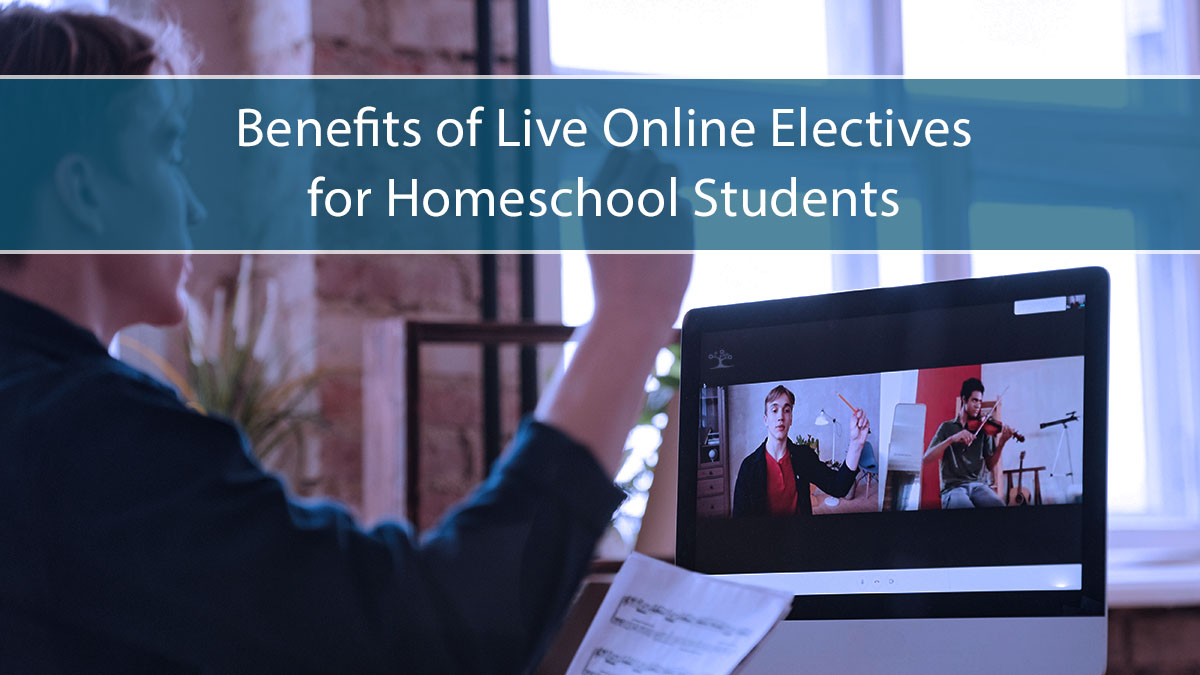
When a student joins a live art class or Spanish course, they’re not learning alone. They’re seeing classmates on screen, hearing other students ask questions, and building a relationship with a teacher who knows their name and their progress. Over a semester, that adds up to something that feels a lot like a classroom community, even though the student is learning from home.
This kind of engagement also supports Branches Learning’s broader approach to instruction, which leans on project-based learning and real interaction rather than passive content consumption. A student isn’t just absorbing information. They’re participating.
How Live Electives Fit Into Your Schedule
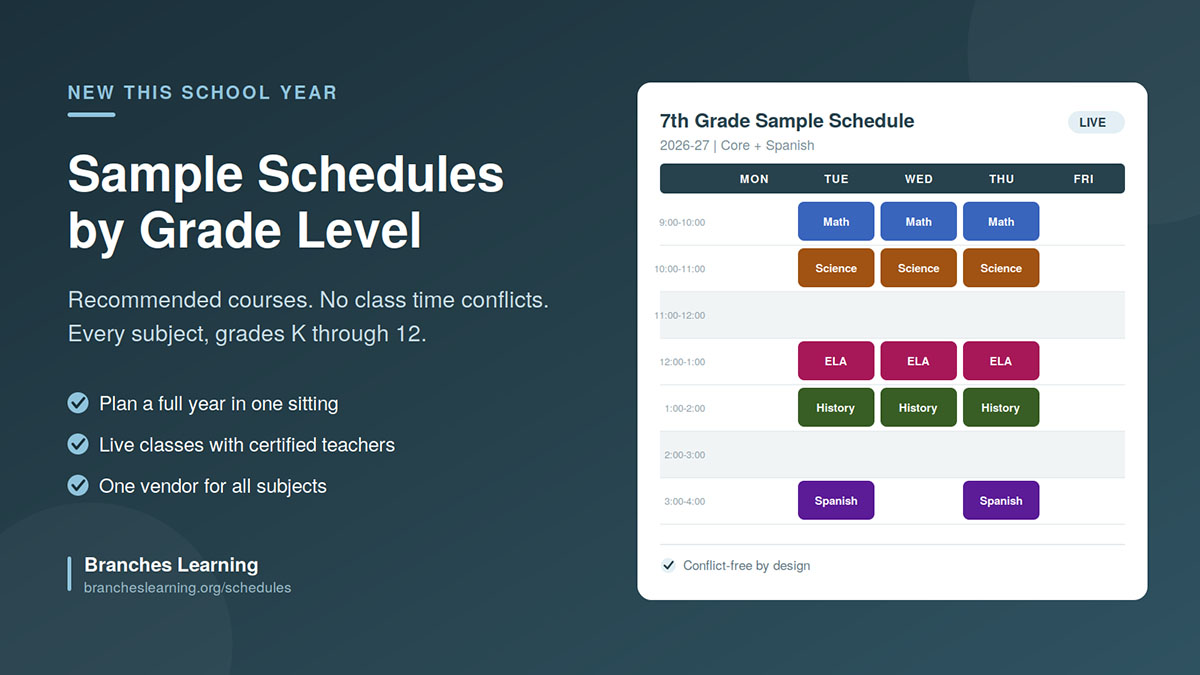
Because Branches Learning electives run on a set live schedule, they slot into a homeschool week the same way any other class would. Most electives meet once or twice a week for about an hour, which makes them easy to plan around core subjects and independent work time.
Your Homeschool Teacher (HST) can help you figure out how an elective fits into your student’s overall educational plan for the year, especially if you’re weighing multiple electives or want to make sure the schedule doesn’t get too packed.
For the 2026-27 school year, course enrollment opened July 6, with live classes beginning August 24. That timing matters if you want your student to have a seat in a specific elective section, since popular courses like Visual Arts and Spanish can fill.
It’s also worth thinking about how an elective interacts with the rest of your student’s week. If your student is already taking several core subjects with Branches Learning, adding one elective is often enough to round things out without overloading the schedule. Families who prefer a lighter academic load sometimes choose a single art or enrichment class as their student’s one live social touchpoint each week, while families building toward college eligibility may add two or three electives with A-G credit in mind. There’s no single right answer. It comes down to your student’s bandwidth and your family’s goals for the year.
How to Enroll in Branches Learning Electives
Enrolling in a Branches Learning elective follows the same process as any other course:
- Browse the course catalog to see current elective offerings, schedules, and teachers.
- Talk with your HST about how the elective fits into your student’s plan for the year.
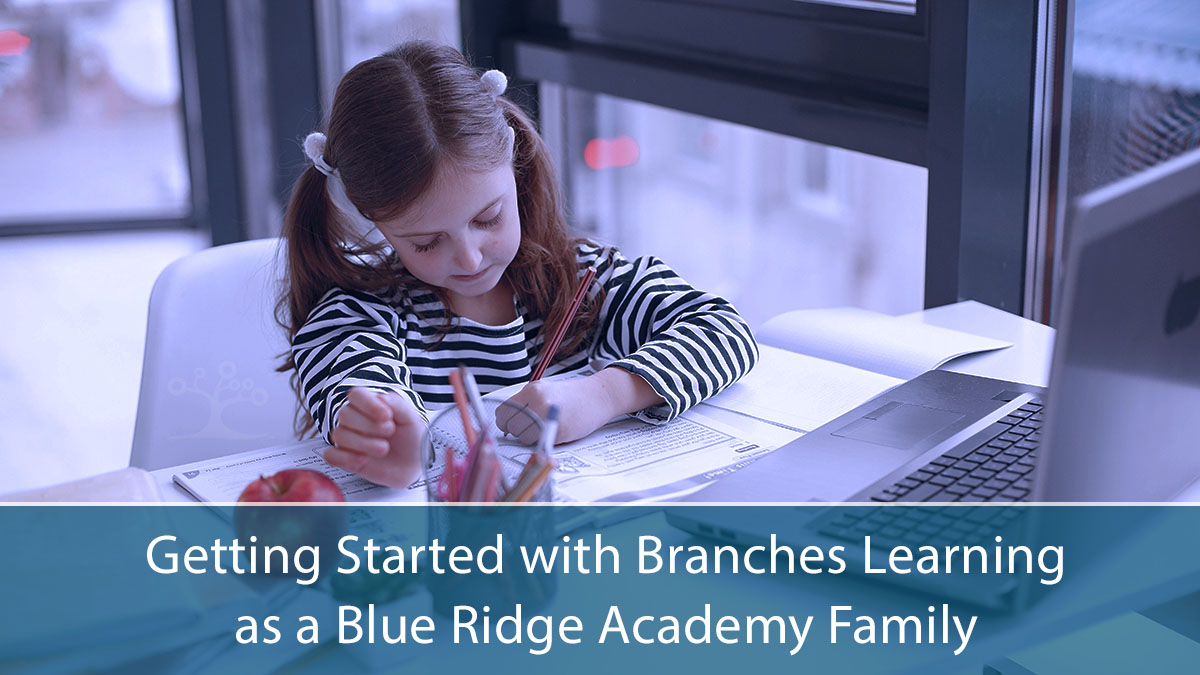
If you haven’t been through this process before, check out “Getting Started with Branches Learning as a Blue Ridge Academy Family,” which walks you through each step in more detail.
A Well-Rounded Year Starts With the Right Electives
Homeschooling through independent study doesn’t mean trading away art class, a new language, or the chance to play an instrument. With live, teacher-led electives, your student gets the same kind of engaged, real-time instruction they’d find in any classroom, just with the flexibility your family needs.
Take a look at the current elective offerings and talk with your HST about which ones might be the right fit for your student this year.
Frequently Asked Questions
Are Branches Learning electives live, or self-paced?
All Branches Learning electives are live and synchronous, meaning students meet with a teacher and classmates on a set schedule rather than working through recorded content alone.
How many electives can my student take?
The right number depends on your student’s overall schedule and course load. Your HST can help you decide how many electives fit alongside core subjects without overloading the week.
Do electives count toward graduation or college requirements?
Several Branches Learning electives, including Spanish 1 AB and above, Visual Arts 1 and 2 AB, and Instrumental Music 1 AB, are A-G credit eligible. Check the course catalog for current credit details on each course.
What elective options are available for younger students?
Elementary students can enroll in live art enrichment classes scaled to their grade band, including Art K-1, Art 2-3, and Art 4-5.
When does enrollment open for the 2026-27 school year?
Course enrollment opened July 6, with live classes beginning August 24.